Digital Signage Expertise

Which digital signage screen is right for your venue?

Choosing the right digital signage display does not depend on its design or price, but on the conditions in which it will be used. The most important factors are the location, lighting conditions, weather conditions, power supply and the desired viewing distance.

With this guide, you can find out in just a few minutes which display solution is best suited to your business.

1. Where is the screen to be used?

Indoors
for controlled indoor environments

Indoor displays are designed for indoor spaces with consistent lighting conditions. They offer excellent picture quality and are ideal for advertising messages, menus or product information.

Typical applications
◆ Restaurants
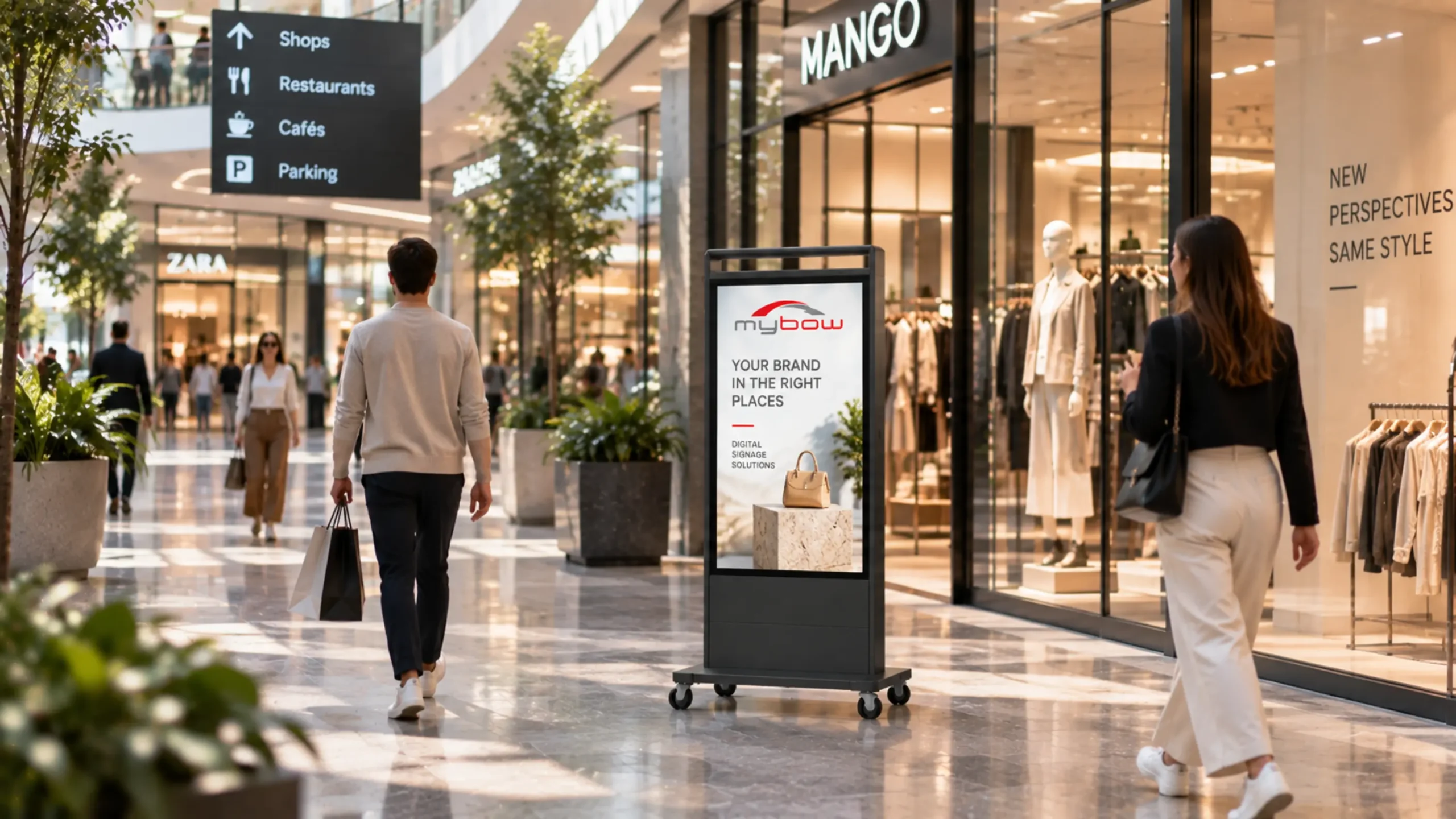
◆ Retail space
◆ Hotels
◆ Reception areas
◆ Shopping centres

Our recommendation
Provided that no direct sunlight falls on the display, an indoor solution is, in most cases, the most cost-effective option.

Recommended solutions
mybow MOVE-EASY
mybow WINDOW
mybow WALL

Semi-outdoor 
enclosed areas with natural light

Semi-outdoor displays are suitable for locations with plenty of daylight, but which are protected from rain and direct sunlight.


Typical applications
◆ Covered entrances
◆ Shopping centres
◆ Passages
◆ Station concourses
◆ Airports

Our recommendation
Many displays appear significantly darker than expected in brightly lit entrance areas. We therefore recommend considerably higher brightness levels for such locations than for standard indoor areas.

Recommended solutions
mybow MOVE-MALL
mybow MOVE-DUAL SEMI

Outdoor 
for year-round outdoor use

Outdoor displays are specially designed to withstand rain, snow, heat and intense sunlight.


Typical applications
◆ Restaurants
◆ Cafés
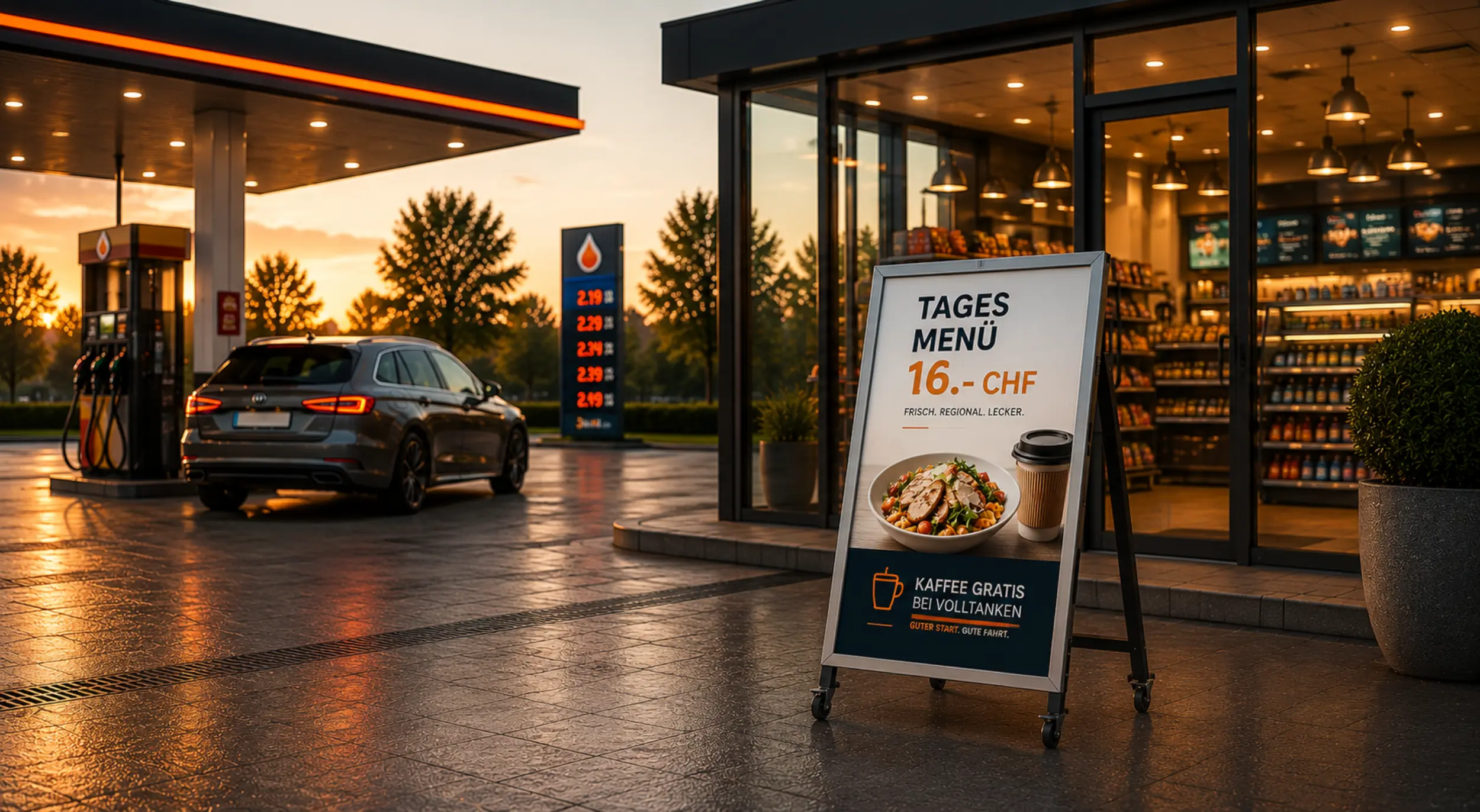
◆ Petrol stations
◆ Hotels
◆ Bakeries
◆ Tourism businesses
◆ Garages

Common mistakes
Many companies opt for a display that is too dim. In summer, the content then becomes almost impossible to read.

Recommended solutions
mybow MOVE-ONE
mybow MOVE-DUAL

2. How much brightness do you need?

The brightness of a display is measured in nits. The brighter the surroundings, the higher this value should be. 

Rule of thumb
The more daylight and sunlight hits the screen, the higher the brightness should be.

Indoors

Recommended brightness:
700–1,500 nits

Semi-outdoor

Recommended brightness:
approx. 3,000 nits

Outdoor

Recommended brightness:
4,000–5,000 NIT

3. Which protection class do you need?

The IP rating indicates the level of protection against water and dust. 

Rule of thumb
It is not the sun that determines the protection class, but the weather conditions.

IP43

Suitable for
◆ covered entrances
◆ Shopping centres
◆ Passages
◆ sheltered outdoor areas

Protection against
◆ Light rain
◆ Splash water
◆ Humidity

Not suitable for
◆ Continuous rain
◆ Unprotected sites

IP65

Suitable for
◆ Outdoor areas
◆ Rain
◆ Snow
◆ Suitable for use all year round

Ideal for
◆ Restaurants
◆ Petrol stations
◆ Hotels
◆ Garages
◆ Tourism businesses


4. Mains power or battery?

Power supply (230V)

Ideal for continuous operation.

Advantages
◆ unlimited duration
◆ high reliability
◆ lighter device weight
◆ no loading times

Battery solutions

Perfect for flexible locations.

Ideal for
◆ Events
◆ Shopping centres
◆ Pop-up shops
◆ PhDs
◆ Sites without an electricity supply

Advantages
◆ No cables
◆ Flexible placement
◆ Portable

Recommended solution
mybow MOVE-ONE AIR

5. Single-sided or double-sided?

Single-sided displays

Ideal for
◆ Walls
◆ Shop window
◆ Inputs

Advantages
◆ cheaper
◆ lighter
◆ easier to position

Recommended solution
mybow MOVE-EASY
mybow MOVE-MALL
mybow MOVE-ONE

Double-sided displays

Ideal for
◆ Walking routes
◆ Shopping centres
◆ Passages
◆ Areas with footfall coming from two directions

Advantages
◆ greater visibility
◆ more attention
◆ greater range

Recommended solution
mybow MOVE-DUAL
mybow MOVE-DUAL SEMI

6. Which pixel pitch is the right one?

The pixel pitch describes the distance between two LED pixels. The smaller this value, the sharper the image appears when viewed from a short distance.

P2.5

◆ top-quality images
◆ short viewing distances
◆ Premium Retail
◆ Shop window

P3

◆ excellent value for money
◆ The standard for many digital signage applications
◆ Suitable for indoor and outdoor use

P4 and above

◆ Long viewing distances
◆ Façades
◆ Large screens
◆ Event spaces

7. LCD, LED or OLED?

We’d be happy to offer you some advice, with no obligation, or show you the equipment during a quick on-site demonstration.

LED displays

LED screens are made up of individual light-emitting diodes and achieve particularly high brightness levels.

Advantages
◆ excellent picture quality
◆ sharp texts
◆ competitive pricing
◆ versatile

Typical applications
◆ Restaurants
◆ Hotels
◆ Bakeries
◆ Shop window
◆ Petrol stations

Recommended mybow solutions
mybow MOVE-ONE
mybow MOVE-DUAL

LCD displays

LCD displays are the most widely used technology in the digital signage sector today.


Advantages
◆ extremely high brightness
◆ perfect in direct sunlight
◆ Large screen sizes are possible

Typical applications
◆ large advertising spaces
◆ Façades
◆ Shopping centres
◆ Event spaces


Recommended mybow solutions
mybow MOVE-EASY
mybow MOVE-MALL

OLED displays

OLED stands for Organic Light Emitting Diode. Unlike LCD, OLED does not require a backlight. Each individual pixel emits light independently.

Advantages
◆ Perfect shades of black
◆ Vibrant colours
◆ Extremely high contrast
◆ Very slim design
◆ Transparent displays are possible
◆ An impressive ‘wow’ factor

Typical applications
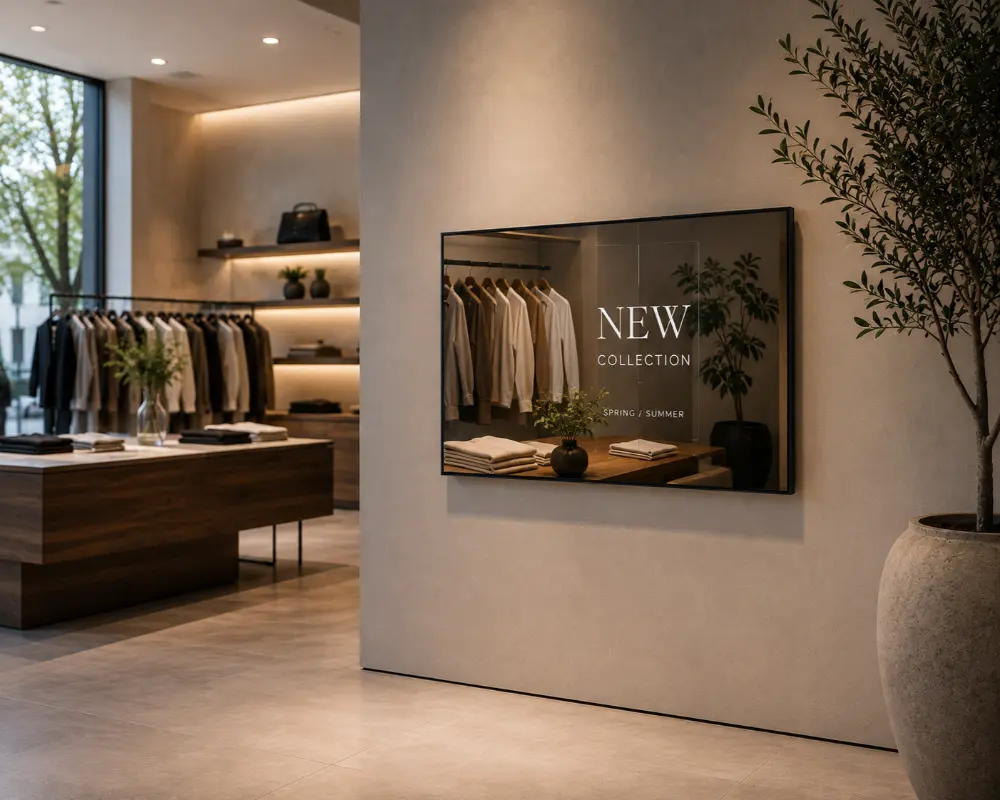
◆ Luxury retail
◆ Showrooms
◆ Trade fairs
◆ Hotels
◆ Premium brands
Unsure? Contact us now
Contact us using the contact form or give us a call to receive a detailed quote.
Contact form
Contact us
info@mybow.ch 
René Bachmann
Tel: +41 (0) 41 212 79 55

State-of-the-art technology

Swiss service 
also on weekends

Personalised support

Copyright © 2026 - Concept by mybow® 
en_GB
linkedin facebook pinterest youtube rss twitter instagram facebook-blank rss-blank linkedin-blank pinterest youtube twitter instagram